





A Salary Certificate Format is one of the most frequently used official documents in all workplaces. You will typically be required to provide evidence of your earnings when applying for a mortgage/loan on your home, visa, credit card, or renting property. Providing an appropriate format of the salary certificate ensures your application is processed promptly. This article provides information about what a salary certificate is, why it is important, what information should appear on the certificate, and how to create a salary certificate in a format acceptable to banks, embassies, and landlords.
What Is a Salary Certificate?
Salary Certificate: An Official Letter Issued by Your Employer That Confirms Your Job Title, Employment Status, Monthly/Annual Earnings. This Letter Is Printed on Your Company’s Letterhead, Signed by One of Their Authorized Representatives (Such as Your HR Manager or Accounts Head) and Usually Has Your Company’s Seal on It.
While a payslip indicates how much you earn each month, a salary certificate provides a complete overview of your compensation and your job security. For this reason, banks and other financial service providers as well as government agencies will typically require a salary certificate as proof of income.
Why a Salary Certificate Is Important
Third parties can use this document as proof of income when verifying income, without having to contact the employer. This is most commonly used for:
- Home, car, and personal loan applications
- Credit card approvals
- Visa and immigration applications
- Rental or lease agreements
- Opening a bank account
- Income tax filing and verification
- School or college admissions that require proof of parental income
A structured salary certificate format can help reduce the possibility of rejection by an organization and build trust with the organization receiving it.
Essential Details to Include
Every professional salary certificate should contain these elements:
- Company letterhead with name, address, and contact details
- Date of issue
- Employee’s full name and employee ID
- Designation and department
- Date of joining
- Employment type (permanent, contract, or probation)
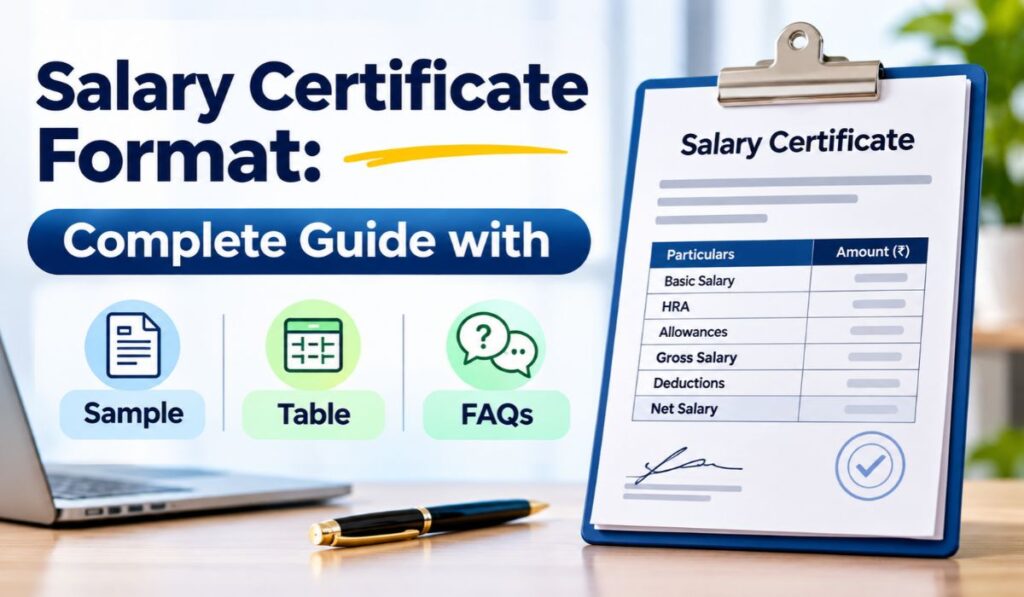
- Salary breakup (basic pay, allowances, deductions, gross and net salary)
- Purpose of the certificate, if required
- Name, designation, signature, and seal of the authorized signatory
The absence of any one of the items above can result in an employer requesting a revised version. Therefore, it is important that each employer use a consistent format when issuing salary certificates to all employees.
Salary Certificate Format Table
The table below displays the critical elements of a full-fledged salary certificate along with how each part must be phrased.
| Component | Description | Example |
| Letterhead | Company name, logo, address, phone, email | ABC Pvt. Ltd., Delhi |
| Date | Date the certificate is issued | 16 November 2026 |
| Employee Name | Full legal name as per records | Rahul Sharma |
| Employee ID | Unique company identification number | EMP-1045 |
| Designation | Current job title | Senior Accountant |
| Date of Joining | Official start date | 01 March 2020 |
| Employment Type | Permanent, contract, or probation | Permanent |
| Basic Salary | Fixed monthly base pay | ₹40,000 |
| Allowances | HRA, travel, special allowance | ₹15,000 |
| Gross Salary | Total earnings before deductions | ₹55,000 |
| Deductions | PF, tax, insurance | ₹6,000 |
| Net Salary | Take-home pay | ₹49,000 |
| Signatory | Name, post, signature, stamp | HR Manager |
Sample Salary Certificate Format
Below is an example that can be used immediately. Copy this to your company’s letterhead and change the information.
[Company Letterhead]
Date: [DD/MM/YYYY]
TO WHOM IT MAY CONCERN
This certificate confirms that Mr./Ms. [Employee Name], with Employee ID [ID], has been employed by [Company Name] in the position of [Designation], within the [Department] department, since [Date of Joining]. Mr./Ms. [Employee Name] is a [permanent/contract] employee.
His/Her monthly salary details are as follows:
- Basic Salary: [Amount]
- House Rent Allowance: [Amount]
- Other Allowances: [Amount]
- Gross Monthly Salary: [Amount]
- Net Monthly Salary: [Amount]
The certificate is being issued per the employee’s request for [use case such as a loan/visa application] and does not carry any financial obligation for the company.
[Name]
[Designation]
[Company Name]
[Signature and Company Seal]
Types of Salary Certificates
There are several types of documents that can be created depending on the situation. However, regardless of the type of document, it will follow the standard salary certificate format. The difference lies in how much detail is included.
- A simple salary certificate is one that specifies only the job title (designation) and the employee’s total monthly salary. This type of certificate may be used for general purposes, such as an application for a rental agreement.
- Detailed salary statement: A complete breakdown of all your income (earnings) and expenses (deductions). This is typically what banks and other financial institutions require from you.
- Some banks offer a standard form for employers to complete and sign.
- The employee’s leave approval, reference to the employment letter, and a commitment by the employee to return to work upon completion of their trip are typically included in an embassy or visa salary certificate.
How to Write a Salary Certificate: Step by Step
Follow these steps to prepare an accurate salary certificate format:
- Gather all relevant employee data from the HR department (Name, ID, Date of Employment, Position).
- Confirm salary figures. Match the amounts with the latest payroll and payslips.
- Use official letterhead. This adds authenticity and brand credibility.
- I will use professional and clear language. I will also avoid using unnecessary words and remain formal in my tone.
- Mention the purpose. If the employee needs it for a visa or loan, state it.
- Get it signed and stamped. An unsigned certificate is usually rejected.
- Keep a copy. Maintain a record in the employee file for future reference.
Salary Certificate vs Payslip vs Offer Letter
The following table provides clarity regarding the differences between the three documents that many individuals confuse.
| Feature | Salary Certificate | Payslip | Offer Letter |
| Purpose | Proof of income and employment | Monthly pay record | Job offer and terms |
| Issued by | HR or accounts department | Payroll system | HR at hiring stage |
| Covers | Ongoing salary and status | One month only | Proposed salary |
| Used for | Loans, visas, rentals | Tax and personal records | Joining formalities |
| Signature required | Yes | Usually no | Yes |
Tips for a Professional Salary Certificate
A salary certificate that is formatted correctly will allow for an easier verification process. When creating a salary certificate remember to keep the following in mind:
- Use a clear font such as Arial or Times New Roman at size 11 or 12.
- Keep the document to a single page.
- Write amounts in both figures and words when needed for visa use.
- Mention the currency clearly.
- Make sure the date of issue is recent, ideally within the last 30 days.
- Please make sure that the human resources department’s contact details are easily accessible for the recipient to confirm.
Common Mistakes to Avoid
Even a slight mistake in the way your salary certificate is formatted can lead to either an immediate rejection of your application, or a delay in processing it. Make sure you don’t make these common errors:
- Wrong spelling of the employee’s name. It must match the passport or ID card.
- Mismatch between payslip and certificate. Figures must be identical.
- Missing signature or seal. Both are usually required.
- Out-of-date certificate. Some banks and embassies will refuse to accept certificates that are older than one month.
- No letterhead. A plain paper certificate looks unofficial.
- Vague salary details. Always specify gross and net amounts.
Legal and Compliance Considerations
The employer must provide accurate information on a salary certificate because it is a legally binding document. If either the employer or the employee provides inaccurate information about income, they could be sued. To avoid this type of problem, organizations need to verify records before completing certificates, create a system for tracking all issued certificates internally, and allow only certain employees to complete and sign certificates. Consistency in the way that salary certificates are formatted throughout the organization will help with audit processes and compliance requirements.
Digital Salary Certificates
Companies have begun issuing digital certificates to employees via their HR portals. Employees receive a digital certificate containing either a digital signature or QR code that may be used to verify the validity of the certificate. Digital certificates allow companies to save time on processing paperwork, and most banks are accepting these types of certificates. However, before submitting a digital certificate to an organization, please check to see if they require a physical copy of the document signed in ink (a “wet signature”) prior to acceptance. This is especially true when applying for visas through embassies.
Conclusion
A salary certificate is a very basic, yet effective tool to verify your income and job status. When employers provide an accurate salary certificate, they will prevent their employees from experiencing delays. Employees that understand the requirements of a salary certificate will be able to ask for the exact information they require. If you follow the standard salary certificate format described in this article, which includes the correct details, a professional layout, and an authoritative signature, you can produce a document that is accepted by financial institutions (banks), foreign embassies, rental property owners (landlords), and government agencies.
FAQs: Salary Certificate Format
1. What is the standard salary certificate format?
The typical layout of a salary certificate will contain the company’s letterhead, the date on which it was issued, the employee’s name, their identification number, job title, when they joined the company, a breakdown of their monthly earnings (salary), the reason for issuing the certificate, and the signature and seal of a designated representative who has authorization to issue such documents.
2. Who can issue a salary certificate?
A salary certificate can be signed and issued by an authorized signatory, such as your HR manager, finance head, or company director. Conversely, self-employed professionals and freelancers will usually need a certified statement provided by a chartered accountant instead.
3. Is a salary certificate the same as a payslip?
No. A payslip provides an individual’s earnings for a single month, whereas a salary certificate verifies that an employee has been employed on a regular basis, and also provides their total annual income. Most financial institutions will request both of these documents at the same time.
4. Is the salary certificate format different for a visa application?
The Visa form of the Salary Certificate format also includes a statement regarding the employee’s approved leave, reason for travel, and when the employee is anticipated to come back to work.
5. How long is a salary certificate valid?
The certificate doesn’t have a specific expiration date, however, many financial institutions and embassies will accept certificates issued in the previous 30 to 60 days. You should always confirm what the recipient expects.
6. Can I create my own salary certificate using a template?
Employees can create a sample document, however, it will need to be verified, signed, and stamped by the employer. An employee-created certificate that does not have employer verification is not valid; therefore, employees should always use an officially accepted salary certificate format provided by their employer.

Dalvi Goyal is a dedicated content writer at TheSalaryInfo.com, specializing in salary insights, career trends, job market updates, and workplace topics. With a strong focus on research and accuracy, Dalvi creates easy-to-understand content that helps students, job seekers, and working professionals make smarter career and financial decisions.