




In addition to the standard line items on your government payslip (like basic salary), there’s another item listed as “DA.” For most new hires, they want to know the DA full form in salary, and how that amount will impact what they can expect to receive each month. We’ve created this guide to provide you with the answers to those questions; as well as, how the DA full form in salary is determined, who receives it, how it’s taxed, and how it’s evolved since its inception.
What Is the DA Full Form in Salary?
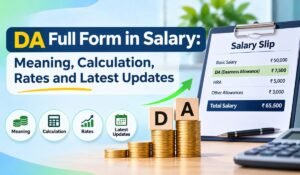
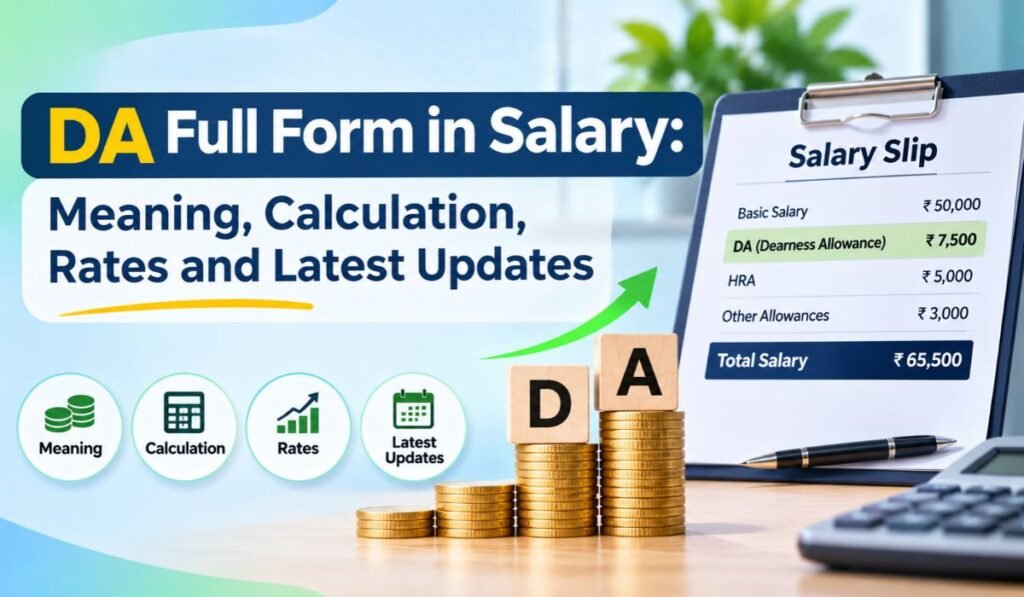
The full form of “DA” in salary is Dearness Allowance. The Dearness Allowance is a cost-of-living adjustment that is added to an employee’s or pensioner’s basic pay as a way to help maintain purchasing power when prices increase. Knowing what the full form of DA stands for in salary is important because DA can be a significant part of a government employee’s overall compensation package.
To put it simply, if the cost of living (food, fuel, rent etc.) increases then your wage will still buy the same amount of goods. DA is the means by which the government compensates for the loss of purchasing power due to inflation. DA is adjusted for central government employees usually twice per year, in January and July.
Why Does Dearness Allowance Exist?
The amount of goods and services that a person can purchase with a given wage will decrease due to inflation. When a pay commission sets a worker’s basic wage, that wage remains constant throughout the year. However, prices continue to change on a monthly basis. If there is no cost of living allowance or other mechanism to offset these price increases, workers will eventually find themselves having less purchasing power.
The DA fills this void. This is because the DA is directly tied to the Consumer Price Index for Industrial Workers (CPI-IW) that monitors the prices of a specific group of products and services. Therefore, when the CPI-IW increases, so does the DA. For this reason, the DA’s full name in salary is frequently referred to as an “inflation protection mechanism” for employees.
Read Also:- HVAC Salary in India | BPSC Teacher Salary | Sevaarth Salary Slip
Who Is Eligible for DA?
DA is mainly paid to:
- Central government employees
- State government employees (rates set by each state)
- Employees of public sector undertakings (PSUs), banks and autonomous bodies
- Pensioners, who receive the same benefit under the name Dearness Relief (DR)
Private sector employees are not paid DA automatically. Some private sector companies provide DA as part of their employee’s total compensation package (particularly in the manufacturing industry); however, there is no requirement for private sector employers to provide this benefit. If someone wants to know the meaning of “DA” in relation to their salary on a private pay slip, they should determine whether the DA is a fixed amount, or if it changes based upon an index.
How Is DA Calculated?
Central Government Employees have their Dearness Allowance (DA) determined by taking a percentage of their base salary. This percentage is based upon the average Consumer Price Index for Industrial Workers (CPI-IW) for the last 12 months. After knowing what DA stands for in your salary, you can understand how it’s calculated.
DA % = [(Average CPI-IW of last 12 months − 115.76) ÷ 115.76] × 100
This is the base value of the index, which was established at 115.76 in the base year 2001 (where 2001=100) under the 7th Pay Commission. It has been rounded off to the nearest full number.
DA amount = Basic Pay × DA %
Example Calculation
| Particular | Amount |
| Basic pay | ₹50,000 |
| DA rate | 58% |
| DA amount (50,000 × 58%) | ₹29,000 |
| Basic + DA | ₹79,000 |
The employee’s monthly earnings from DA would be ₹29,000 based on their ₹50,000 basic pay. Therefore, it is clear how significant DA is within the overall salary system.
DA Rate History (Central Government)
The rate has increased steadily over the past few years, as the table shows.
| Effective From | DA Rate |
| January 2023 | 42% |
| July 2023 | 46% |
| January 2024 | 50% |
| July 2024 | 53% |
| January 2025 | 55% |
| July 2025 | 58% |
The above table shows that DA full form in salary refers to an allowance which increases based on inflation. The Union Cabinet announces these changes periodically, typically several months after they go into effect, and pays back-dated payments for the time in between. Although rates for after July 2025 might be available at this point, please refer to the most recent official announcement from the Ministry of Finance or Department of Expenditure.
Read Also:- Data Engineer Salary | IAS Salary After 10 Years | Web Developer Salary
DA vs HRA vs TA: Key Differences
The term DA full form in salary can be confusing to many individuals due to the existence of various types of allowances. This table helps clarify the differences among these different types of allowances.
| Allowance | Full Form | Purpose | Based On |
| DA | Dearness Allowance | Offsets inflation | Basic pay and CPI-IW |
| HRA | House Rent Allowance | Helps pay rent | Basic pay and city category |
| TA | Travel Allowance | Covers commuting costs | Pay level and city |
| CCA | City Compensatory Allowance | Higher cost of living in big cities | Location |
DA is the only part that will change with inflation. Your HRA will depend on your location of residence, while your TA will be determined by your rank and the city in which you are posted.
DA for State Government and PSU Employees
States have the authority to establish their DA rates, and therefore, they are generally different than that of the Central Government. Several states may adopt the Central Government’s rate in a short period of time, whereas other states may delay the adoption due to financial constraints. Employees of Public Sector Undertakings (PSUs) typically adhere to the rules and regulations prescribed by the Department of Public Enterprises (DPE), and their DA is calculated using a different index and base. Employees working in banks receive DA as per the terms of bipartite agreements, and these agreements provide for quarterly revisions to the DA.
When comparing job offers, be sure to keep in mind that the DA full form in salary represents the same thing across all employers, however, the rate of pay and how it is calculated may vary depending on the employer.
Is DA Taxable?
Yes. DA is fully taxable. DA is part of your gross salary and therefore is added to your taxable income under the head “Income from Salary.” Your employer will deduct tax at source (TDS) according to your income tax slab. Since DA is a major component of your salary, an increase in DA means an increase in your taxable income. When studying the DA full form in salary for tax planning purposes, you must keep in mind that unlike some portions of HRA or travel allowances, DA does not receive exemptions.
DA and the Pay Commission
The Pay Commissions examine their salary systems about once every decade. Usually, the DA of the previous commission will be combined with the basic pay of the new commission. After the merge, the DA will start over again. The 6th Pay Commission was an example of this happening, as well as the 7th Pay Commission, which reset DA after merging it into the pay structure.
The government has also established the 8th Pay Commission, and employees are waiting to see if DA is going to be merged with basic pay. Regardless of the outcome, the DA full form in salary will always remain Dearness Allowance, and it will always function as an inflation adjustment.
How DA Affects Other Benefits
DA does not only increase your monthly pay. It also influences:
- Pension and Dearness Relief (DR) – Pensioners are given DR at the same rate as currently working employees.
- TA and other allowances: Some allowances increase automatically when DA crosses certain levels.
- Salary and DA (dearness allowance): DA is included as a component of the salary base used for most of the calculations related to gratuity and leave encashment.
- PF contributions are typically based upon the basic salary and dearness allowance (DA).
The knowledge of what DA stands for in your paycheck will help you make decisions about planning for retirement, not just about your monthly earnings.
Read Also:- Police Patil Salary | RRB JE Salary | NABARD Grade A Salary
How to Check DA on Your Payslip
- Open your latest payslip from your employer’s portal.
- Find the “Earnings” section and locate the DA line.
- Divide the DA amount by your basic pay and multiply by 100.
- Compare the result with the latest official DA rate.
Ask your accounting department for an update on any pending revisions or arrears if the numbers do not line up. You will be able to find discrepancies much faster when you know what the “DA” full form means in relation to salaries and the current rate of DA.
Common Mistakes to Avoid
- Assuming DA is a fixed amount. It is a percentage that changes.
- Forgetting that DA is taxable.
- Confusing DA with DR. DA is for serving employees and DR is for pensioners.
- Ignoring arrears when a revision is announced late.
By understanding what the DA full form is in a person’s pay check, as well as understanding how the DA works in a practical setting, will help you avoid making the same errors.
Conclusion
Dearness Allowance (DA) is one of the most vital components of a salary package for Government and PSU employees. DA helps keep employee salaries at par with escalating prices and is revised periodically depending upon the Consumer Price Index for Industrial Workers (CPI-IW).
As you are now familiar with the DA full form in salary, how DA is determined and how DA is taxed, you will be able to comprehend your payslip more easily and make more informed financial decisions. The DA full form in salary may seem like an insignificant matter, however, it has a substantial effect on your earnings, retirement benefits and savings.
Frequently Asked Questions
1. What is the DA full form in salary?
The DA in Salary stands for “Dearness Allowance”. It is a Cost-of-Living Allowance that employees and Pensioners receive to compensate for inflation.
2. How often is DA revised?
As per current rules, DA for Central Government Employees will be reviewed twice every year (Effective Dates – 1st January & 1st July). However, the revision announcements are generally made a few months after these effective dates and the employee gets paid arrears.
3. Is DA included in basic salary?
No, DA (Dearness Allowance) is a separate payment from the employee’s basic pay. When there is a new pay commission, the current DA can be combined with the employee’s basic pay. Understanding the DA full form in salary allows you to understand why DA is listed on the salary slip as a separate item.
4. Is DA taxable?
Yes, DA is part of your taxable salary and is subject to deduction of tax by the employer at the time of payment.
5. Do private employees get DA?
The inclusion of DA into your salary structure by some private employers, does not have a legally binding obligation to do so.
6. What is the difference between DA and DR?
Dearness Allowance (DA) is provided to employees on active duty, whereas Dearness Relief (DR) is provided to retired employees. The rate of both allowances is identical, and they are both intended to offset the effects of inflation.

Dalvi Goyal is a dedicated content writer at TheSalaryInfo.com, specializing in salary insights, career trends, job market updates, and workplace topics. With a strong focus on research and accuracy, Dalvi creates easy-to-understand content that helps students, job seekers, and working professionals make smarter career and financial decisions.