






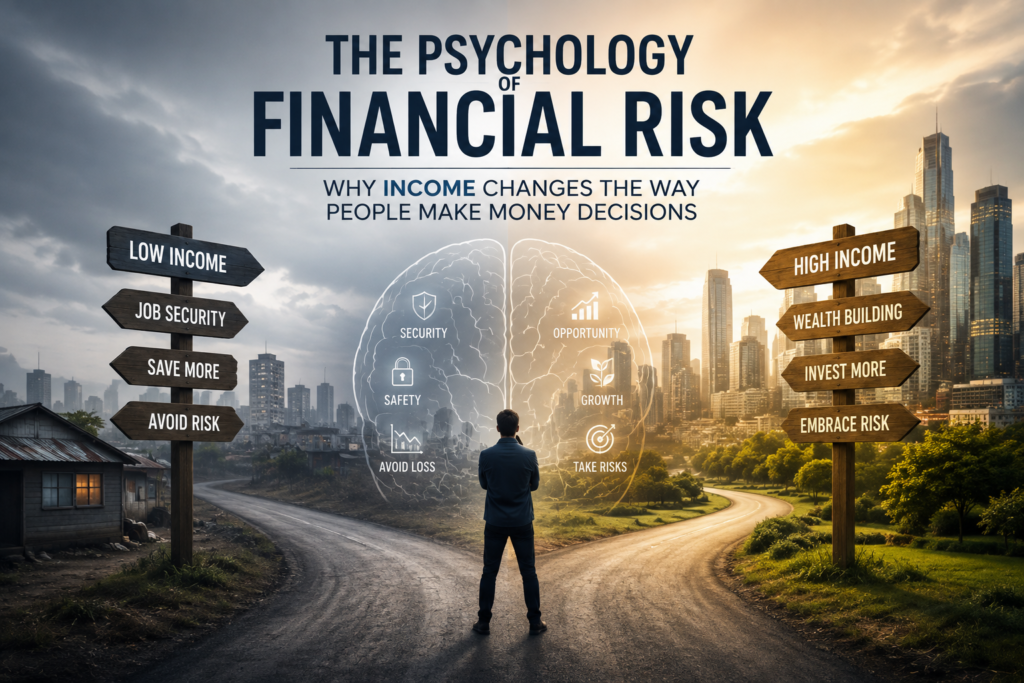
Money decisions rarely depend on numbers alone. Two people can face the same financial choice and reach very different conclusions. Their income, savings, monthly expenses, and sense of financial security all shape how much risk feels acceptable.
Financial risk is the possibility that a money decision will produce a worse result than expected. The same risk can feel minor to one person and serious to another. Losing a fixed amount has very different consequences for someone with substantial savings than for someone who needs that money for next month’s bills.
Income therefore changes more than purchasing power. It changes the margin for error.
A person with stable earnings and emergency savings can often absorb an unexpected expense without changing daily life. Someone with little spare income has less room to recover. Even a small loss may affect rent, food, transport, or other essential costs.
Psychology adds another layer. Fear can make people avoid reasonable opportunities. Confidence can push them toward risks they have not fully examined. A sudden increase in income may also create a false sense that larger losses have become harmless.
Good financial decisions begin by separating what is possible from what is affordable. Income provides useful context, but it should never be the only measure of risk. Savings, obligations, time, and the consequences of a poor outcome matter just as much.
Disposable Income Changes How Risk Feels
Essential Money And Flexible Money Carry Different Weight
A salary does not show how much money a person can safely spend.
Two workers may earn the same amount but have very different obligations. One may support a family, repay debt, or face high housing costs. The other may have lower fixed expenses and more savings. Their real capacity for financial risk is therefore different.
The useful figure is disposable income after essential costs and planned savings.
Small Amounts Can Carry Different Consequences
Context changes the meaning of a financial loss.
Spending $50 may have little effect on someone with a large monthly surplus. For another person, the same amount may cover several days of groceries or transport. Looking only at the number hides the real impact.
This principle applies across discretionary spending, from subscriptions and hobbies to games and other forms of entertainment. Those interested in the broader psychology of uncertain outcomes can read more about how expectation, probability, and immediate feedback shape digital experiences.
Higher Income Does Not Remove Bias
Earning more can increase financial flexibility, but it does not guarantee better judgment.
People may increase spending as their salary rises. They may also assume that a larger income makes every financial risk easier to absorb. This can create lifestyle inflation, where expenses grow almost as quickly as earnings.
A stronger approach measures risk against the money left after essential needs, savings, and existing obligations. That provides a clearer picture of what a person can genuinely afford to lose without disrupting more important financial goals.
Financial Security Changes The Way People Judge Uncertainty
Savings Create A Buffer Against Bad Outcomes
Income matters, but financial reserves often matter more when judging risk.
Savings act like a shock absorber. An unexpected repair, medical bill, or temporary loss of income becomes easier to manage when cash is available. Without that buffer, even a modest surprise can force someone to borrow money or delay another important expense.
This is why two people with identical salaries may have very different levels of financial security.
People Often Focus Too Much On The Best Outcome
Uncertain financial choices can attract attention because the potential reward is easy to imagine.
The possible loss receives less attention, especially when the reward feels exciting or immediate. This pattern appears in speculative investments, competitions, games of chance, and other situations where outcomes cannot be guaranteed.
A better question is not simply, “What could I gain?” It is also, “What happens if this money is gone?”
That question shifts attention from possibility to consequence.
Clear Limits Reduce Emotional Decisions
Financial decisions become harder when excitement, fear, or urgency enters the picture.
Setting limits in advance can reduce this pressure. A person can decide how much money belongs to essential expenses, savings, long-term goals, and optional spending before an emotional situation appears.
The same principle applies when readers read more about probability-based digital experiences or other activities built around uncertain outcomes. A clear boundary separates entertainment spending from money needed elsewhere.
Financial security does not require avoiding every risk. It requires understanding which losses can be absorbed and which ones could damage essential goals. That distinction allows people to evaluate uncertainty with greater clarity instead of reacting only to the size of a possible reward.
Better Financial Decisions Start With The Cost Of Being Wrong
Income affects financial choices, but salary alone does not define what someone can safely risk. The more useful measure is the amount left after housing, food, transport, debt payments, savings, and other essential commitments have been covered.
This distinction explains why financial risk is personal. A loss that causes little disruption for one household may force another to postpone an important payment. Looking at the possible reward without measuring the effect of a loss gives only half the picture.
Strong financial judgment therefore begins with consequences rather than possibilities. Before committing money to an uncertain outcome, it helps to ask what would change if that money never returned. If essential expenses or important goals would suffer, the financial risk is larger than the amount alone suggests.
Emotions can still influence this calculation. Excitement makes potential rewards easier to picture, while confidence can make unfavorable outcomes seem distant. Fear can create the opposite problem and discourage reasonable choices. Clear limits help keep both reactions in check.
Ultimately, income changes the capacity to absorb risk, but it does not make uncertain outcomes predictable. Savings, obligations, time horizons, and financial goals all matter. People make stronger money decisions when they understand these limits before emotion enters the equation.
The goal is not to remove every form of uncertainty from financial life. That would be impossible. The more practical goal is to take risks whose negative outcomes can be managed without threatening essential needs. That approach turns financial risk from an emotional reaction into a measured decision.