






Investment Banker Salary in India 2026: If you have ever scanned the landscape of finance and thought to yourself, who are the people who are closing billion-rupee deals – they are investment bankers. We are at the very top of the financial advisory ecosystem in India serving most of the corporations, government and private equity firms on mergers, acquisitions, IPOs and capital raising. And yes, their earnings are as impressive as their work product.
Now here is the reality: when you search for investment banker salary in India, you will mostly get broad estimates or already 2 years old data that will tell you virtually nothing. This guide is different. This comprehensive toolkit has it all – number to skip to specific packages, role-wise breakup, city-wise comparison, top bank packages, cut-off/bonus structure, everything you need to know about what 2026 actually looks like in this part of the world for its Investment Banker Salary – whether you are a commerce kid figuring out your future, an MBA graduate plotting your career or a finance professional benchmarking your own package.
What Does an Investment Banker Actually Do ?

Understand what investment bankers are paid forBefore we discuss money, it is helpful to know what investment bankers are paid for. These are more than your typical bank managers assisting clients in breaking open the piggy bank for a savings account. Investment bankers are generally dealing with some of the most complex and high-stakes financial transactions in the world. They assist companies in raising capital by issuing stocks and bonds. They do consulting for mergers and acquisitions the merging of two huge corporations, or an outright purchase of one by the other.
They underwrite initial public offerings or when a private company sells stock to the public. They also perform intensive financial analysis, construct valuation models, and prepare pitch books that can often be hundreds of slides long. It requires analytical thinking, long working hours, financial modelling, efficient communication skills, and the ability to remain balance in extreme pressure. This is the exact reason Investment Banker Salary in India are eternally the highest paying salaries in any sector.
Read Also:- CA Salary in India | Software Engineer Salary | AI Engineer Salary
Investment Banker Salary in India 2026: The Overview
As per Glassdoor data, the national average Investment Banker Salary in 2026 in India is around ₹31.5 lakh per annum. But that number on its own does not tell the complete picture. As a whole spectrum, it is too wide from about ₹6 lakh per annum for fresh-out-of-college analysts to over ₹1.5 crore per annum for Managing Directors in top global banks. It is over ₹44 lakh for the 90th percentile, and that does not take performance bonuses into account, which at the senior levels tend to be equal to, if not more than, the base salary.
The answer for that is the structure of compensation in investment banking which is unique. In contrast to most industries where you receive a fixed amount each month, investment banking pay is an amalgam of base pay, year-end performance bonuses, signing bonuses (especially if you switch from another firm), and at much higher levels of seniority, equity or profit sharing. The ₹1.5 crore for a Managing Director you see quoted in articles is often just the fixed component in a good year for deals, the total package (including bonuses) can cross the ₹3 to 5 crore.
Role-Wise Investment Banker Salary Breakdown
Read Also:- Data Scientist Salary | BSc Nursing Salary
Investment Banking Analyst (0–3 Years)
The analyst is where nearly every investment banking career gets its start. This is the level at which fresh graduates (usually IIMs, IITs, top commerce colleges or global B-schools) come on board. It is also a very data-heavy and execution-driven role, where you will be doing things like: building financial models, running valuation analyses, building pitch decks, doing industry research, and supporting associates and VPs in live deals. During active deal periods, hours can lengthen to 80–100 per week, hence the compensation at even an entry level is vastly above most other career routes for a given age bracket.
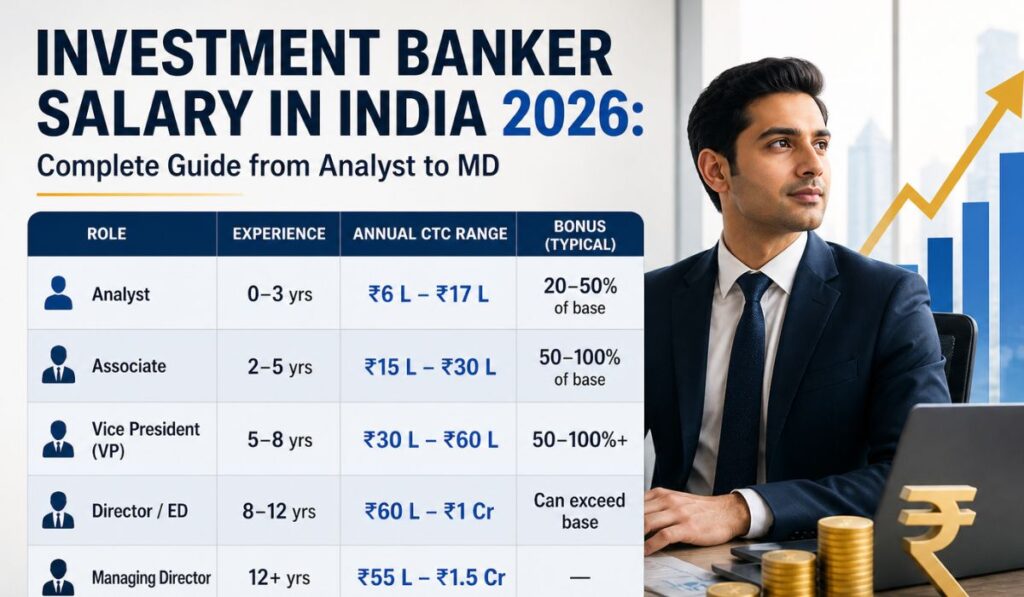
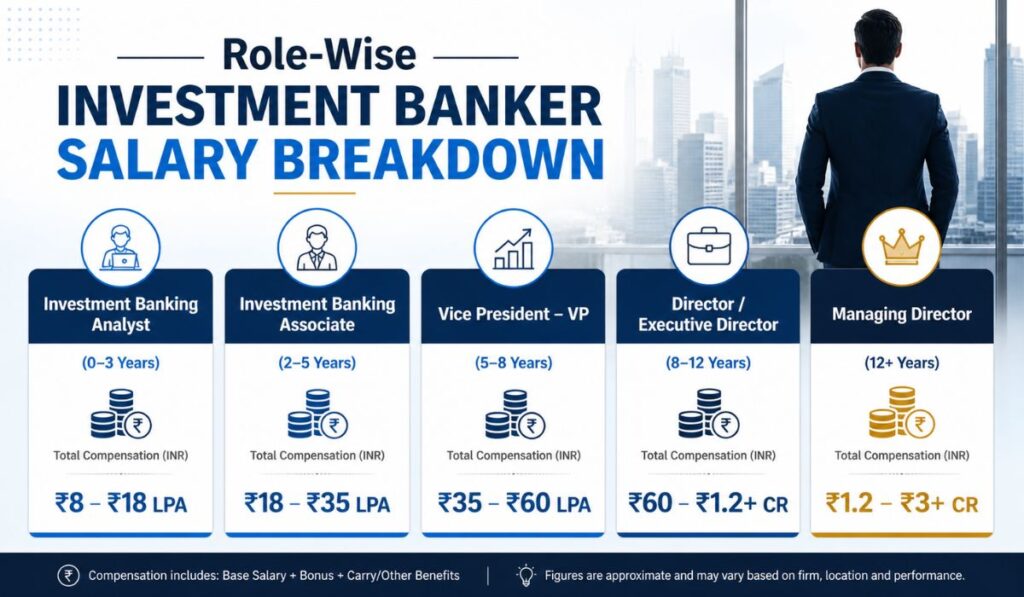
Investment banking analyst salaries in India (for 2026) range from ₹6 lakh to ₹17 lakh (at domestic firms), but top global banks like Goldman Sachs and JP Morgan routinely pay ₹18 lakh to ₹28 lakh per annum. Freshers at the analyst level earn between ₹50,000 and ₹1.2 lakh a month, depending on the firm and the city. Performance bonuses at this level range from 20% to 50% of base and can add a substantial amount on top of the total compensation where deal flow is solid.
Investment Banking Associate (2–5 Years)
Following this, after a couple of years (as an analyst either garnering a promotion or through an MBA at a top school) they get promoted to the associate level. Associates not just executing but managing. They oversee analysts, lead client presentations, start managing deal processes from end-to-end, and take on increased responsibility for financial accuracy and client communication. The transition from analyst to associate is arguably the most important one in banking in terms of responsibility and money within the whole career ladder.
In 2026, associate-level Investment Banker Salary in India will be between ₹15 lakh to ₹30 lakh per annum, depending on performance, and an average of ₹35 lakh for top performers at global banks. Monthly take-home is between ₹1.3 lakh and ₹2.5 lakh. At this stage, bonuses are between 50% and 100% of base salary, so a top associate at a bulge-bracket bank can easily bring home, on a good year, a total contract value of ₹40 lakh or more.
Vice President – VP (5–8 Years)
Title of Vice President in Indian investment banking is not only a fancy title. VPs are deal wranglers they manage multiple deals at once; they have the relationship with the client beyond the pitch, they lead teams on individual deals and are responsible for the quality of both the analytics work and client experience. VP is typically five to eight years of sustained high performance, so naturally, the compensation reflects that seniority sharply.
An average VP level salary in India offers ₹30 lakh to ₹60 lakh per annum in base pay thus it can be assumed to be your monthly salary of ₹2.5 lakh to ₹5 lakh before bonuses. Bonuses even match or outstrip base salary particularly at the global banks when deal volumes are soaring. At targets, in addition all else a top performing VP at Goldman Sachs or Morgan Stanley can easily cross ₹80 lakh to ₹1 crore per annum in Mumbai.
Director / Executive Director (8–12 Years)
Directors are the very second highest rung of the investment banking ladder. They own the client relationships, lead the deal origination, manage the large teams and are held accountable for bringing in business and not just servicing it. The transition from VP to Director is competitive and far from a given; it requires an independent revenue-generating prowess.
In India, director-level base salaries range from ₹60 lakh to more than ₹1 crore per annum. Even, large global banks have base salaries for senior directors that often cross ₹1 crore, with a top payout (including bonuses) of ₹2 crore or more in banner years. This works out to ₹6 lakh to ₹10 lakh per month in fixed pay, translating into one of the highest-paying jobs in Indian corporate finance.
Managing Director (12+ Years)
The Managing Director ranks at the very top of the investment banking career hierarchy. A MD oversees the biggest transactions, the most critical client relationships, and the strategic direction of their division. Getting to that tier typically takes more than 10 years of outstanding performance, a solid network of clients, and a proven ability to close big deals on their own.
The base pay of an MD in India primarily in 2026 ranges from ₹55 lakh to ₹1.5 crore per annum, with bonuses that can double, or even triple that number. Including base, bonus, profit and stock-linked incentives, total compensation can go as high as ₹2 crore-₹5 crore or even more for MDs in a good year at some of the top global banks.
Investment Banker Salary Table by Role
| Role | Experience | Annual Base (INR) | Typical Bonus |
|---|---|---|---|
| Analyst | 0–3 years | ₹6 L – ₹28 L | 20–50% of base |
| Associate | 2–5 years | ₹15 L – ₹35 L | 50–100% of base |
| Vice President | 5–8 years | ₹30 L – ₹60 L | 50–100%+ |
| Director / ED | 8–12 years | ₹60 L – ₹1 Cr | Can exceed base |
| Managing Director | 12+ years | ₹55 L – ₹1.5 Cr | 100–200%+ |
Read Also:- 15 LPA In Hand Salary | 3 LPA in Hand Salary | 4.5 LPA In Hand Salary
City-Wise Investment Banker Salary in India

| City | Analyst Salary Range | Key Insight |
|---|---|---|
| Mumbai | ₹10 L – ₹20 L | Financial capital, 10–20% premium over others |
| Delhi NCR | ₹8 L – ₹16 L | 10–20% above national average |
| Bengaluru | ₹7 L – ₹14 L | Strong VC & startup ecosystem |
| Chennai / Pune | ₹3.6 L – ₹9 L | Tier-2 hubs, 5–15% lower |
Almost as important as the role you have, is where you work. Investment banking in India is located mainly in a handful of cities, and pay reflects that concentration starkly.
Mumbai is not called the financial capital of India for nothing. This is home to the BSE, NSE, the HQs of nearly all the large global banks India operations and most of the front-office deal activity. All levels of investment bankers working in Mumbai earn on average atleast 10–20% more than national averages. In Mumbai, an analyst earns between ₹10 lakh to ₹20 lakh a year, and that range is lower in other cities.
The Delhi NCR region is the second most buoyant job market, offering 10% to 20% more than the national average salaries. The strength of the M&A advisory, governmental transaction and the headquarters of multiple domestic conglomerates, in the NCR region, also means high degree of requirement of investment banking services at regular intervals. Bengaluru has become a third established integrated hub, increasingly led by the tech sector as a result of the startup funding, venture capital, and PE explosion. Bengaluru, relatively more expensive than Mumbai but growing rapidly, sees analysts making ₹7 lakh to ₹14 lakh.
Those Bengaluru and Hyderabad pains are real think Tamil Nadu to the South and Maharashtra to the West as genuine second-tier opportunities, particularly in support functions and offshore homes for global firms, but salaries continue to be in the 5% to 15% inferior bracket to the top three metros.
Read Also:- 12 LPA In Hand Salary | 6 LPA In Hand Salary | 10 LPA in Hand Salary
Top Paying Investment Banks in India (2026)
Not all banks pay equally. A bulge-bracket bulge global firm versus a smaller domestic boutique can pay at least ₹10 lakh or more higher than the analyst level itself and the difference gets much higher at senior levels.
Apart from that, Goldman Sach and Morgan are always among the highest payers among global bulge-bracket banks in India. For example, Goldman Sachs analyst packages vary between ₹18 lakh and ₹28 lakh a year while Morgan Stanley varies between ₹10 lakh to ₹30 lakh depending on the division and the deals exposure. Analysts on the JP Morgan desk in India are paid ₹20 lakh to ₹25 lakh while associates earn ₹32 lakh or above. Citi and Bank of America complete the boujee global pay winners, with analysts pulling in between ₹12 lakh-$22 lakh apiece. Mid-market: Jefferies and HSBC ₹10 lakh to ₹18 lakh for entry level professionals
Within domestic investment banks, Avendus Capital, Kotak Investment Banking, Axis Capital, ICICI Securities and JM Financial remain the biggest paymasters year after year. Their analyst packages start from ₹8 lakh and can go up to ₹15 lakh, with lucrative bonuses linked to deal activity. Base pay here is slightly lower, job security is high and deals are mostly government-related.
Here is Some Top paying banks in India (analyst level)
| Bank | Type | Approx. Analyst CTC |
|---|---|---|
| Goldman Sachs | Bulge Bracket | ₹18 L – ₹28 L |
| Morgan Stanley | Bulge Bracket | ₹10 L – ₹30 L |
| JPMorgan Chase | Bulge Bracket | ₹20 L – ₹25 L |
| Citigroup / Bank of America | Bulge Bracket | ₹12 L – ₹22 L |
| Jefferies / HSBC | Mid Market | ₹10 L – ₹18 L |
| Avendus Capital / Kotak Mahindra Bank / Axis Bank | Domestic | ₹8 L – ₹15 L |
| ICICI Bank / JM Financial / SBI Capital Markets | Domestic | ₹6 L – ₹12 L |
Pros and Cons of a Career as an Investment Banker in India
Investment banking is not an industry for everybody. The rewards are great but so too the demands. This is how things play out on both sides of the coin, in truth.
Pros of an investment banking career in India:
It is actually one of the top pay packages for finance grads in the entire country at the minute. Analysts earn multiples of what their commercial banking counterparts or accounting classmates could possibly take home the entry level. It takes only about 3 years to go from analyst to associate, and about 10 years to become VP. It is some of the most intricate and intellectually stimulating financial problems in the space.
Global Banks: International Exposure, Cross-Border Deals and Access to global networks opening doors to almost all private equity, hedge funds, and corporate strategy roles around the world. Investment banking is viewed as one of the best “exit opportunity” careers – alums go to PE, VC, CFO roles, and entrepreneurship at disproportionately high rates.
Cons of an investment banking career in India:
The hours are grueling, especially at the analyst and associate levels. It is not an exaggeration to say your training is to work 80 to 100 hours a week when deals are live the latter is the actual expectation at top firms. The work-life balance is extremely poor for the first few years of the career. There is no such thing as job security; deal flow disappears and bonuses shrink in times of economic trouble, and even the biggest banks lay off workers.
It’s extremely competitive to break in most bulge-bracket roles hire massively from IIMs, ISB, IITs and global B-schools; making it very tough for anyone who does not have an elite academic pedigree to enter. The lifestyle does take its toll mentally and physically, and consequently burnout rates among the first few years in the career can be high.
What Boosts Your Investment Banker Salary in 2026?
Some qualifications/skills for 2026 are associated with higher starting salaries, and quicker promotions and larger bonuses.
An MBA from the right school – either a premier Indian school (IIM Ahmedabad, IIM Bangalore or ISB Hyderabad) or global schools (Wharton, LBS, INSEAD etc) is probably the single largest lever for a higher starting Investment Banker Salary. At most leading international banks, all Managing Directors and senior vice presidents hold an MBA from one of the leading business schools.
Professional certifications which give a marginal benefit over the degree: CFA (Chartered Financial Analyst), FRM (Financial Risk Manager), CA (Chartered Accountant) certification is recognised by a number of domestic and foreign global firms for the rigour. It’s also true in 2026: technology skills are hot investment bankers with Python for financial modelling, Power BI for data visualisation or an understanding of AI-enables deal analytics are earning 10% to 20% pay premiums vs finance-only peers.
Between growth in mergers & acquisitions/ cross border transactions, fintech advisory, and financial structuring for blockchain stocks, repeat scenarios of future value creation needs to expand M&A, cross border transactions tax, Fintech consulting and Blockchain financial structuring professions continue to grow demand for these specialists.
Investment Banker Salary in India vs USA
To put this in perspective, Indian based Investment Banker Salary need to be compared with global standards. An analyst at a bulge-bracket investment bank in America gets a base salary of $110,000-$125,000 i.e., ₹90 lakh to ₹1 crore and a cash bonus of $50,000-$100,000. This is significantly higher than the ₹6 lakh to ₹28 lakh range at that level in India.
But when you consider the cost of living, tax rates, and purchasing power, the gap shrinks significantly. Which in their context is the relevant comparator: Indian investment bankers remain among the highest paid in the country. A significant number of Indian professionals leverage India-based roles to springboard into top global banking sources like NY, London, Singapore, or HK both the deal sizes and pay scales climb exponentially.
FAQs: Investment Banker Salary in India 2026
Q1. What is the starting Investment Banker Salary in 2026 in India?
The starting salary for analysts (fresh graduates) at domestic investment banks in 2026 would be in the range of ₹6 lakh and ₹17 lakh per annum while leading global banks such as Goldman Sachs or JP Morgan would pay a starting salary of ₹18 lakh to ₹28 lakh at the same level. For top MBA programmes, say IIMs or ISB, the starting packages ranges between ₹18 lakh and ₹30 lakh, again depending on the firm.
Q2. How much can an investment banker earn in India? more than ₹1 crore every year?
Yes, absolutely. Base salary alone can go well above ₹1 crore for the Directors and Managing Directors at some of the largest banks across the globe. In roaring deal years, total compensation of senior investment bankers crosses the ₹2 crore to ₹5 crore mark often, once performance bonuses, profit sharing and stock based bonus are factored in.
Q3. What is the highest Investment Banker Salary in India, in which city?
Investment Banking Salary in India: Mumbai vs. All India – Mumbai salary levels are consistently amongs the highest in India, anywhere from 10% to 20% above All India average for practically every level. Delhi NCR rank second, and Bengaluru at third. Due to high concentration of global bank headquarters are based in the city, major deal activity and the two stock exchanges i.e. BSE and NSE located in Mumbai as well, it is an undisputed hub for the profession.
Q4. Are investment banking bonuses guaranteed?
No, bonuses for investment banking was completely performance-based and based on nothing guaranteed. They rely on individual performance, deal volume, deal size, bank performance, and market performance. Bonuses are known to equal two or even three times base salary in strong deal years. In weak marketplaces or poor economies, bonuses are lessened significantly or totally.
Q5. CFA vs MBA: Which Is Better for Investment Banking in India?
Both are useful, but they have a different job to do. Its an MBA from a top institute (IIM, ISB, global B-school) that remains the ultimate ticket to break into ‘front office investment banking at the associate level and immensely increases starting salary (most gainfully employed MBA by steep margins very few other domains come close). CFA is more relevant mainly for people working in the industry and trying to develop deeper analytical credibility, especially in research, asset management, and mid-to-seniority banking roles. If you had to choose, the combination of both gives you the best positioning possible.
Q6. Main skills that enhance an investment banker salary
The same drivers of higher pay in 2026 are advanced financial modelling and valuation, M&A deal execution experience, senior-level client relationship management, degrees of proficiency in data analytics tools (such as Python or Power BI), and skill sets in newer areas, including fintech advisory, AI-based financial analysis, and cross-border deal structuring.
Conclusion
Investment banking: It continues to be among the highest-paying careers in India in 2026 but it is not a ‘fallback option’. It requires years of preparation, elite credentials, and a remarkable capacity for pressure and long hours. Well, the numbers are real: Indian Investment Banker Salary truly creep from ₹6 lakh as a freshman analyst to ₹1 crore plus as a Managing Director in an investment bank and beyond, depending on your experience, performance and who your employer is.
2026 is particularly interesting because of the change taking place behind the scenes. Aspects that once were nice-to-have additions to a banker profile technology fluency, AI literacy, fintech expertise are quickly becoming differentiators in Investment Banker Salary. It is the bankers who combine the classic skills of deal execution with the modern data and technology capabilities who are being paid at the top of every range.
However, you can still leave your mark here and if Investment Banking is what you want to pursue, the path is very predictable (if you do not have any other options): technical foundation, top MBA or certification (extensive deal experience through internships), focus on return to Mumbai-based global banks (where the chances and remuneration is highest). The journey is arduous but for those willing to be all in, the benefits come 2026 are stronger than ever.

Dalvi Goyal is a dedicated content writer at TheSalaryInfo.com, specializing in salary insights, career trends, job market updates, and workplace topics. With a strong focus on research and accuracy, Dalvi creates easy-to-understand content that helps students, job seekers, and working professionals make smarter career and financial decisions.