






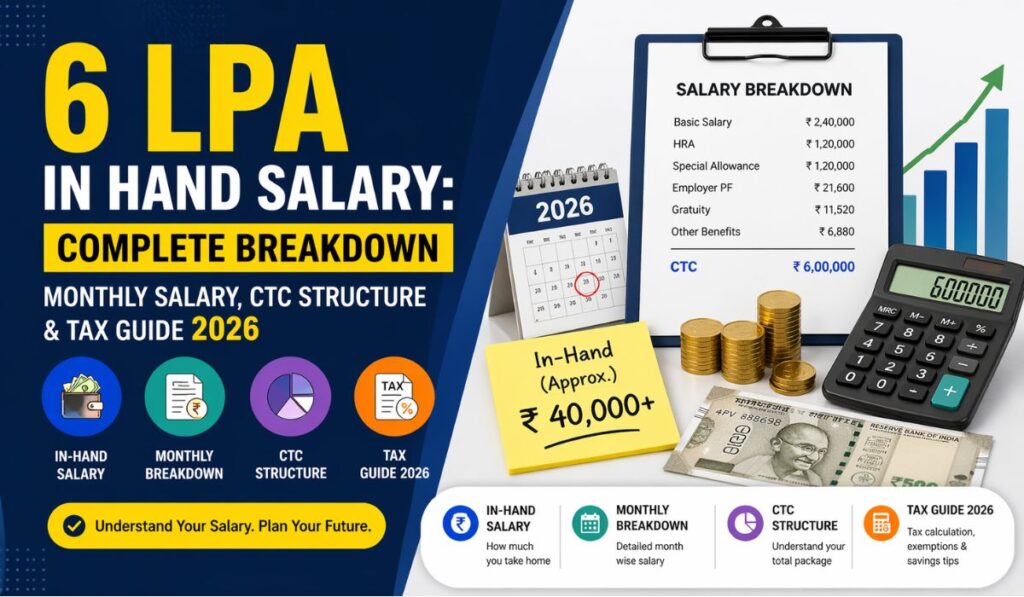
When analyzing job offers, many candidates place importance on the CTC (Cost to Company) of the position. The in-hand salary or the amount you will receive each pay period after deductions, will determine how much enjoyment you will have in your lifestyle, savings, and financial planning. If you have been offered a 6 LPA in hand salary and are working on developing a career path based around that salary, you should understand how much money you will actually have as in-hand salary on a monthly basis.
This guide will provide an overview of in-hand salary calculations, take-home pay on a monthly basis, salary structure and tax implications related to receiving it and ultimately determining how much money you are really making from your employment.
What is 6 LPA In Hand Salary ?

A 6 LPA in hand salary means the amount of money that you receive after all deductions (like income tax, EPF, and any other contributions) have been taken from your total salary.
So it’s important to know what CTC is (i.e., the total amount that has been spent by the company on your employment) vs. what “in-hand” means (the actual amount of money that you will receive).
This means that if someone is earning a 6 LPA CTC in hand salary, then the amount they will actually receive will always be less than INR 6,00,000, unless explicitly stated as their fixed take-home.
Read Also:- 10 LPA in Hand Salary
Difference Between CTC and In Hand Salary
A lot of job-seekers think that CTC equals your monthly pay. However, CTC has many components in it that don’t include money you get directly but other types of compensation for working for an employer, such as health insurance, retirement plans, and paid time off.
CTC Includes:
1. Basic Pay
2. HRA
3. Special Allowances
4. Pay raises and promotions
5. Company pension fund contributions (employee PF contribution)
6. Insurance and other benefits
In-hand Salary Consists of:
1. Basic Pay
2. Allowances
3. Minus All Deductions (Tax, EPF Contributions, Insurance)
So, when you are assessing how much money to factor into your budget based on a CTC 6 LPA in hand salary, consider that deductions affect your real income.
Formula to Calculate 6 LPA In Hand Salary
To help you estimate your net income, use the following formula:
In Hand Salary = Gross Salary – (Income Tax + EPF + Professional Tax + Other Deductions).
Gross Salary = Basic Salary + HRA + Allowances + Bonuses
The gross salary is calculated by adding together, all parts of your overall compensation package: your base salary, house rent allowance (HRA), allowances, and bonuses
This calculation is in place for all levels of income.
Read Also:- 5 LPA In Hand Salary in India
Estimated Salary Structure for 6 LPA CTC
Here’s a practical overview of how a salary of INR 6 LPA is typically structured in most organizations:
Earnings
| Component | Monthly (INR ) | Annually (INR ) |
| Basic Salary | 25,000 | 3,00,000 |
| HRA | 10,000 | 1,20,000 |
| Conveyance Allowance | 1,600 | 19,200 |
| Medical Allowance | 1,250 | 15,000 |
| Other Allowances | 12,150 | 1,45,800 |
| Total Earnings | 50,000 | 6,00,000 |
Deductions
| Component | Monthly (INR ) | Annually (INR ) |
| EPF (12%) | 3,000 | 36,000 |
| Professional Tax | 200 | 2,400 |
| Health Insurance | 800 | 9,600 |
| Total Deductions | 4,000 | 48,000 |
6 LPA In Hand Salary Per Month
The most useful number for the majority of people in the workforce is their average monthly salary. A CTC of INR 6 lakh per annum, usually your 6 LPA in hand salary per month, ranges from 43,000 to 48,000 and this varies depending on the following:
- Company policies
- Salary structure
- Tax law
- Benefits and deductions
So in general terms, you can anticipate an approximate monthly take-home salary of INR 45,000.
Scenario: Fixed 6 LPA In Hand Salary
If a company gives you an INR 6 LPA as fixed in hand salary, this means your actual CTC is higher than INR 6 LPA.
| Component | Monthly (INR ) | Annually (INR ) |
| Basic Salary | 22,000 | 2,64,000 |
| HRA | 9,000 | 1,08,000 |
| Other Allowances | 19,000 | 2,28,000 |
| Gross Salary | 50,000 | 6,00,000 |
Additional CTC Components
| Component | Annual (INR ) |
| Employer PF | 36,000 |
| Insurance | 10,000 |
| Total CTC | INR 6.5–INR 6.7 LPA |
Components of 6 LPA Salary
You can negotiate a higher salary and develop better negotiation skills by understanding your full salary structure.
Basic Salary
Usually makes up between 40% and 50% of your CTC
Used in calculating PF and HRA
House Rent Allowance (HRA)
Usually 40% to 50% of your basic wage and may be tax-deductible based on certain conditions.
Special Allowance
Flexible and varies widely.
Taxable under all conditions.
Bonus
Bonus is paid based on your performance but isn’t guaranteed each year.
Employee Provident Fund (EPF)
EPF is calculated at 12% of your basic salary and is matched by your employer.
Professional Tax
Fixed amount per pay slip.
This amount varies depending on your state.
Tax on 6 LPA Salary (New Tax Regime 2025–26)
The most recent taxation system includes:
1. A standard deduction of INR 75,000.
2. Those with incomes of lower than INR 1,200,000 (i.e., Rs 12,00,000) can apply for an income rebate after just a few conditions have been fulfilled.
| Particular | Amount (INR ) |
| Gross Salary | 6,00,000 |
| Standard Deduction | 75,000 |
| Taxable Income | 5,25,000 |
As you can see from the example above, the amount of taxes you are going to be assessed for has been reduced significantly due to the application of the standard deduction and rebate. As a result of this, nearly all full-time employees who earn less than this amount will find a ‘final’ tax liability to be zero.
Old vs New Tax Regime Comparison
| Feature | Old Regime | New Regime |
| Deductions | Available | Limited |
| Complexity | High | Low |
| Tax Savings | Investment-based | Automatic |
| Tax on 6 LPA | Low | Usually Zero |
For most people, the new system provides ease and reduced requirements for compliance.
How to Calculate 6 LPA In Hand Salary Yourself
To work out net pay from your gross salary (CTC), you have to find the total amount that the employer contributes towards your employee provident fund (EPF); this is done by taking the reduction from the total amount. After this, subtract the total amounts of EPF, professional tax, insurance, and income tax and divide the remaining amount by 12; that will result in a realistic estimate of a 6 LPA CTC in hand salary.
Factors Affecting 6 LPA In Hand Salary
Multiple factors will impact your net income or take-home salary such as:
Company Salary Structure
Different companies have different ways of allocating salary components to the employee.
Location
The metro cities listed as being part of an urban center usually provide higher housing rent allowances; however, they also have more deductions for those allowances.
Bonuses and Variable Pay
Certain forms of variable compensation can dramatically affect wages and total earnings.
Tax Regime Selection
Choosing an appropriate tax regime is a large factor for withholding taxes.
Benefits and Perks
Employee-received meal cards, health insurance, and similar benefits are all counted as income while counting net salary.
Common Mistakes to Avoid
Common mistakes people make when trying to determine their salary include:
- Mixing CTC and in-hand salary together
- Not taking into account deductions from CTC
- Overestimating your net pay each month
- Not understanding about taxes and tax liabilities
- Incorrectly choosing the tax regime
Avoiding these common mistakes will result in improved financial management.
Why Understanding In Hand Salary Matters
Understanding your in hand salary for 6 LPA allows you to make wiser and more realistic financial decisions at home every day. By knowing exactly how much you receive each month rather than relying upon the larger CTC amount, you can accurately budget for your regular monthly expenses.
- Plan your regular monthly expenses so that you do not overspend.
- Build savings and investments with a clear and accurate picture of your monthly income.
- Negotiate better employment offers based on the actual take-home pay you will receive every month.
- Eliminate miscalculations when creating your financial plan, which will eliminate any unexpected shortfalls.
When using your in hand salary instead of the more inflated CTC number to determine your current financial position, you gain a reality of your situation versus the more inflated CTC. Therefore, you are able to accomplish your goals in terms of being financially secure and being prepared.
Conclusion
Having clarity of a 6 LPA in hand salary helps in making better financial decisions. Although 6 LPA looks great as a CTC figure, on average, your take-home will be equivalent to 45,000 per month. To reiterate, CTC is the total amount you will be paid to the company, whereas the take-home amount is the amount you receive. By knowing how to interpret the various salary elements, understand the deductions, and the tax implications, you will be able to accurately compare job offers. When you have clarity on a 6 LPA CTC in hand salary and a 6 LPA in hand salary per month, you will know how to better plan your finances and make smarter decisions about choosing your career.
FAQs
Is 6 LPA a good salary?
Yes, 6 LPA is a decent entry- to mid-level salary in India.
Is a 6 LPA salary taxable?
Under the new tax regime, tax is usually zero on a 6 LPA salary after a 75,000 standard deduction and rebate benefits.
What is 6 LPA CTC in hand salary?
A 6 LPA CTC in hand salary typically ranges from 5.2 to 5.6 LPA annually after all deductions like EPF, tax and insurance.
What is the salary of 6 lakh CTC in hand?
The salary of 6 lakh CTC in hand is around 43,000 to 45,000 per month, depending on the deductions.
What is a 6 LPA salary per month?
A 6 LPA salary per month is 50,000 gross per month with an average of 45,000 in hand salary.

Dalvi Goyal is a dedicated content writer at TheSalaryInfo.com, specializing in salary insights, career trends, job market updates, and workplace topics. With a strong focus on research and accuracy, Dalvi creates easy-to-understand content that helps students, job seekers, and working professionals make smarter career and financial decisions.