






Safety engineer salary in India has emerged as one of the most searched topics for engineering graduates and working professionals in 2026. Industries such as construction, manufacturing, oil and gas, and infrastructure have been growing at a fast pace, hence the increased need for qualified safety professionals which resulted in average pay across experience levels and cities to increase significantly. In this article, we will explore the Safety Engineer salary in 2026 including entry-level, mid-level, and senior level compensation, variations by city and industry and certifications that can help you earn more.
Overview of Safety Engineer Salary in India 2026
Depending on the data source, company size, geography and expertise, pay in this field may vary widely. The salary varies from 2.5 lakh per year for freshers to 19+ lakh per year for higher professionals with an experience of more than 8 years, according to different salary portals. In India, the average safety engineer gross salary is ₹17,26,971 or an equivalent hourly rate of ₹830. On the other side of this spectrum, some portals that record entry-level and mass-market positions report average numbers closer to ₹25,494 a month.
This large gulf exists because “safety engineer” is the title of both junior safety officers on construction sites and senior process safety or functional safety engineers in oil, gas and chemical plants. As a result, what you can expect when it comes to specialization, certification, and industry is closely tied.
As per PayScale, the average total safety engineer salary in India in 2026 is approximately ₹4,20,000 per annum. On the other hand, portals that cater to senior and expert-level positions show far higher numbers as process safety, functional safety and HSE (Health, Safety, Environment) engineering roles are more technical skill specific which makes them a premium service owing to rules of regulation.
Read Also:- SBI Manager Salary | SBI CBO Salary | GST Inspector Salary
Safety Engineer Salary by Experience Level
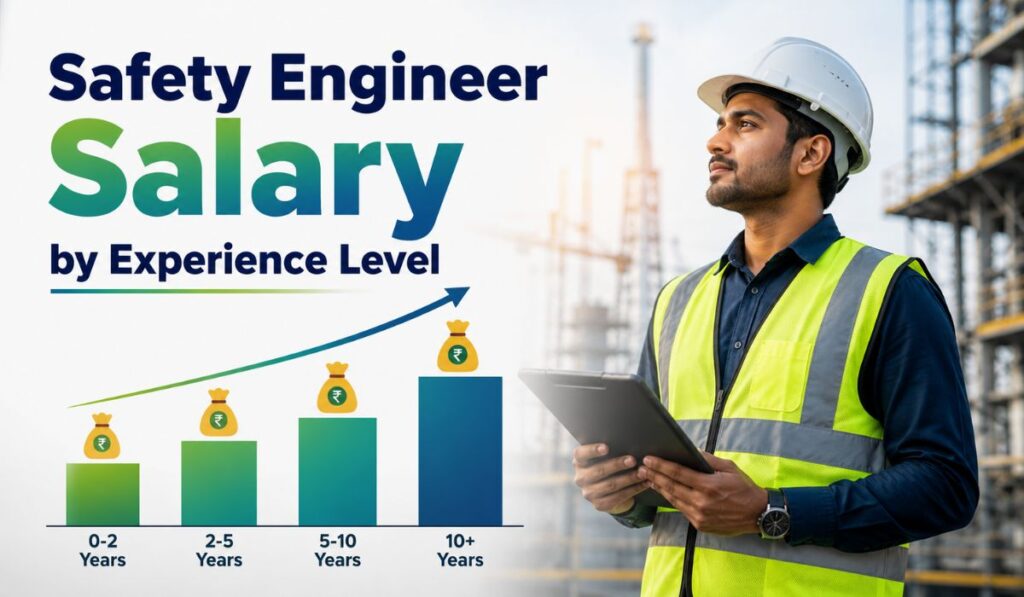
Pay is mainly dependent on experience. Here is annually how the safety engineer salary progresses through career stages:
| Experience Level | Years of Experience | Average Annual Salary (₹) | Average Monthly Salary (₹) |
| Entry-Level | 0–1 years | 2,50,000 – 3,00,000 | 20,000 – 25,000 |
| Junior | 1–3 years | 3,70,000 – 5,00,000 | 30,000 – 42,000 |
| Mid-Level | 3–5 years | 5,00,000 – 8,00,000 | 42,000 – 66,000 |
| Senior | 5–8 years | 8,00,000 – 12,00,000 | 66,000 – 1,00,000 |
| Lead / Principal | 8+ years | 12,00,000 – 20,00,000 | 1,00,000 – 1,65,000 |
A fresh graduate at the entry-level, with less than 1 year of experience gets an average total compensation (includes tips, bonus) ₹2,50,000 while a mid-career Software Engineer with 1–4 years of experience earns an average total compensation of ₹3,73,711. On the senior side, a professional with 8 or more years of experience makes an average ₹19,90,348/year as against ₹12,32,735 for those who have 1–3 years of experience.
That means that the pay can increase nearly 5 to 6 times from entry-level to senior or principal level, and even a higher peak for those entering into process safety and functional safety engineering which are among the most lucrative niches in this area. At the middle of their careers HSE Engineers are paid close to ₹1,00,000 per month and as much as ₹1,70,000/month for senior specialists like Lead Process Safety Engineers until ₹2,80,000/month at the level of Principal.
Safety Engineer Salary by City in India
The major factor affecting the payment is also the location of this job since industrial hubs and metro cities provide better paid than smaller towns. Here it is for 2026 approximately by metro:
| City | Average Monthly Pay (₹) |
| Mumbai | 35,000 – 55,000 |
| Bengaluru | 34,000 – 52,000 |
| Chennai | 30,000 – 48,000 |
| Pune | 32,000 – 50,000 |
| Delhi NCR | 33,000 – 51,000 |
| Hyderabad | 31,000 – 47,000 |
| Vadodara / Gujarat belt | 30,000 – 46,000 |
| Tamil Nadu (state average) | 23,795 |
Average salary: ₹23,795 per month in Tamil Nadu, India. Salary reported from 102 employees through Indeed over the past 36 months. For cities having a good number of oil refineries, chemical plants, heavy manufacturing – like Mumbai, Vadodara, and parts of Gujarat – safety engineer salary is usually higher due to more regulatory and safety-compliance burden placed by the industries in that region. Karnataka, Assam and Rajasthan are the three states where this job is paid highest in India.
Safety Engineer Salary by Industry
The kind of industry you are working in has a huge influence on the safety engineer salary. Other sectors, in particular oil and gas, chemicals, and heavy construction tend to pay the highest premiums because the risks are greater and compliance is legally required.
| Industry | Relative Pay Level |
| Oil & Gas / Petrochemicals | Highest (premium pay) |
| Chemical & Process Industries | Very High |
| Construction & Infrastructure | Moderate to High |
| Manufacturing | Moderate |
| Power & Energy | Moderate to High |
| IT / Corporate Facilities | Lower |
Process Safety engineers and functional safety engineers are among the highest paid safety engineer in India within oil and gas and chemical process industries. The design of IEC 61511 SIS work falls into the Functional Safety domain, while Process Safety Engineering mostly involves HAZOP and LOPA analysis, so it stands to reason that both classes of work will be at the top of the salary table; in fact these jobs often out-earn general HSE roles by substantial amounts at similar years of experience.
Read Also:- OT Technician Salary | Merchant Navy Salary | Para Commando Salary
Entry-Level vs Experienced Salary Comparison
Follow the compensation culture, a little bit to get an idea of how much your pay can sway with career growth: as fresher-level vs experienced-level comparison.
| Factor | Fresher / Entry-Level | Experienced (8+ years) |
| Average Annual Package | ₹2.5 – 3 lakh | ₹12 – 20 lakh |
| Job Role | Site safety assistant, junior officer | Lead engineer, HSE manager |
| Certifications Held | Basic diploma, IOSH | NEBOSH, OSHA, IOSH, functional safety |
| Industry Placement | Construction, general manufacturing | Oil & gas, chemical, energy sector |
| Decision-Making Authority | Limited, works under supervision | Designs safety programs, leads audits |
The safety engineer salary comparison shows that it is not stagnant; this increases significantly with certifications, specialization and years of work in the field.
Factors That Influence Safety Engineer Salary
Several factors govern how much safety engineer salary a candidate can demand in the Indian market:
- Experience – In the example provided, salary rises sharply with years in a relevant field.
- Certifications – Certifications such as IOSH, OSHA and NEBOSH have a direct impact on salaries: Professionals with a NEBOSH qualification make nearly 10–15% more than their counterparts with only an IOSH certification.
- Type of Industry – The safety engineer salary for the oil and gas, petrochemicals, heavy manufacturing industries is often higher than those in lighter industries.
- Location – Higher compensation is paid by all metro cities or industrial hubs as compared to small towns.
- Multinational corporations and large industrial groups usually offer competitive salary packages higher than small local firms.
- Specialization– The process safety and functional safety specialists earn quite a bit more than the general site safety officer.
- Education Level – This industry, like many others suffers from low employment levels and advanced degrees will help to furnish professionals with the necessary skills to earn promotions and contribute to overall IP GDP growth.
How Certifications Boost Safety Engineer Salary

Certifications are still among the quickest ways to increase your safety engineer salary in India. The IOSH Managing Safely is usually your quickest entry into the professions, with a cost of ~ ₹18,000–25,000 & with duration of around 4 days. After certification, professionals usually begin in entry-level positions and move on to mid- or senior-level career stages.
New IOSH/OSHA certified professionals with junior positions such as checking daily, incident reports and training workers will earn around ₹25,000–35,000 a month at the entry level. Is this one useful to you,In the mid-level period of 2–5 years, those who lead teams (3 look and a company director/ independent auditors) generate ₹35,000–50,000/month- Ideally most people reach this level after 3 years and more at four years. Senior-level (5–10 years) An OTHM or NEBOSH certificated safety program designer can earn ₹50,000–75,000/month. The above progressive linkages between upskilling and earnings seem to suggest that earning potentials are passively increased through a non-tenure based approach towards learning.
In fact, pay in India related to safety has increased nearly 15% over the last two years, and a further upward glory of around 10–12% is anticipated for these professionals throughout 2027–2028, creating an unmistakable pattern that guarantees a firm upward pathway for Safety engineer salary patterns maintaining into at any rate quite a while.
Read Also:- ML Engineer Salary | Google Software Engineer Salary | Mechanical Engineer Salary
Government vs Private Sector Pay
Safety engineers are also hired in government organizations, public sector undertakings and regulatory authorities but here the pay is on fixed scales with grade-based increments (and not market negotiation). Private sector positions (especially in oil and gas or large multinational manufacturing companies) tend to be for the safety engineer salary a higher, more flexible private sector position plus performance bonuses, housing allowances and site-based bonuses for using dangerous locations.
We are also seeing increasing popularity for consulting-based pay structures. You can find independent safety consultants in India Affordable rates are ₹1,200–2,500 per hour or ₹50,000–150,000 or more per project but this form of income is less predictable as it depends on building up a good line up of clients after that you can also have strong income.
Future Outlook
The long term future for the safety engineer pay scale in India looks to be great. Estimated salary potential for this role over the next five years based on current compensation data. The ease of access to improved workplace accuracy and safety is helping the growth that is being driven by stricter regulations, increasing industrial activity, and increased emphasis on compliance in work environments such as construction, manufacturing, and energy production.
With the ever-growing infrastructure, renewable energy and chemical-processing capacity in India, demand for certified safety professionals is likely to remain high which would keep average salaries on the rise over the next few years.
Conclusion
In 2026, the safety engineer salary in India varies from around ₹2.5–3 lakh per year for freshers to well over ₹15–20 laakh per year for senior process safety and functional safety specialists working in oil, gas, and chemical industries. Final pay can vary substantially based on city, industry, certification level and years of experience. If yours is a profile where you want to make the most money, certification from a globally recognized name such as NEBOSH, IOSH or OSHA and working in an industry like oil & gas (high-risk, high compliance) is still the safest bet for a long term financial growth in this field.
FAQs
1. What is the average safety engineer salary in India in 2026?
The figures depending upon the source of data, domain and experience average from around ₹2.5 lakh per year for fresher to about ₹17–20 lakh per year for seniors/specialised professionals.
2. What is the starting pay for freshers in India?
For freshers, the entry-level safety engineer salary can be between ₹20,000–35,000 / month or approximately around ₹2.5–3 lakh annually as per company and location.
3. Which industry offers the highest pay for this role in India?
The higher safety engineer salary in India comes from oil and gas, petrochemicals and process industries because these roles are the most-specialized as compared to any other sector or industry can achieve at a greater level.
4. Does certification increase earnings?
Yes, certification hugely affects the compensation of a safety engineer. NEBOSH-salaries generally earn around 10–15% more than an individual with just a basic IOSH certification and this gap increases further at senior levels.
5. Which city in India pays the highest for this role?
Cities with firm industrial and manufacturing centers, such as Mumbai, Bengaluru, Pune, and Delhi NCR along with states like Karnataka, Assam, and Rajasthan pay better than small cities.
6. Will pay for safety engineers in India increase in the coming years?
Yes, the salary of safety engineer is forecasted to rise in the foreseeable future with analysis hinting approximate 29% growth as compared to previous five years because of stringent rules on safety along with industrial expansion and increasing demand for certified professionals.

Dalvi Goyal is a dedicated content writer at TheSalaryInfo.com, specializing in salary insights, career trends, job market updates, and workplace topics. With a strong focus on research and accuracy, Dalvi creates easy-to-understand content that helps students, job seekers, and working professionals make smarter career and financial decisions.